Birthright and Inheritance: Why a Grandson Cannot Sue for Property His Father Received Under Section 8
1. Introduction
Hindu family law has long carried two ideas about property that sit uneasily together. The first is that a son acquires an interest in joint family property by the fact of his birth into the family. The second is that when a man dies, his property passes to his heirs according to a statute. In J. Rajesh v. M. Kumaran, the Supreme Court had to say which idea prevails when the two meet.
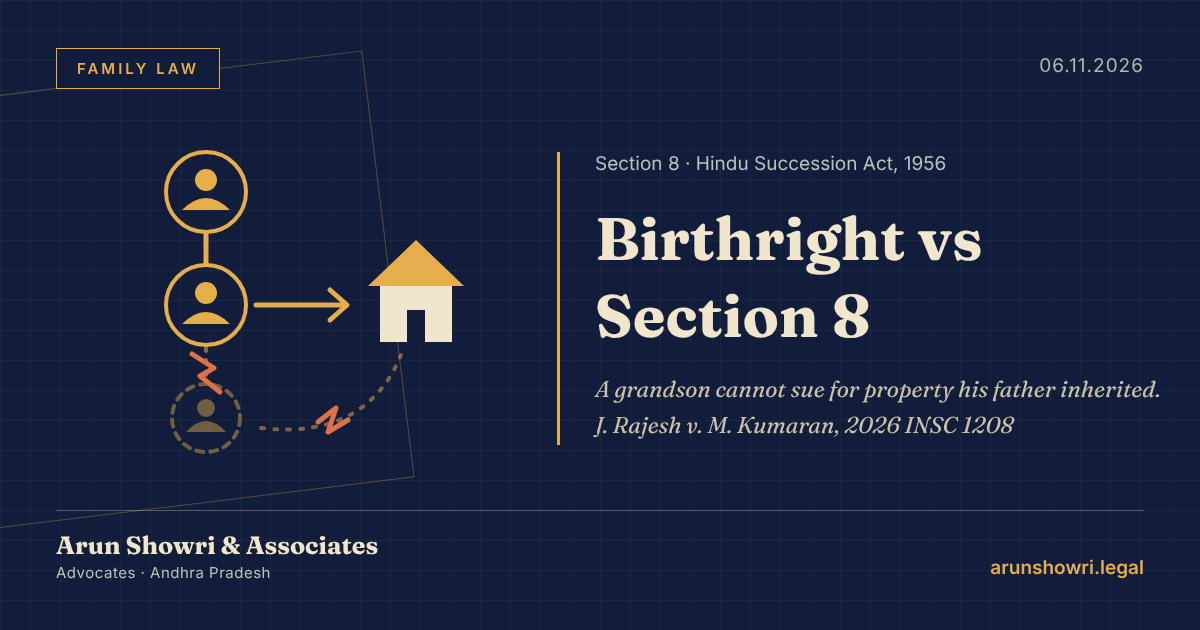
The Court framed the question in a single sentence: whether the appellant was entitled to a half share in the property of his father, who was still alive, and could seek partition on the premise that the property was ancestral or joint family property. The answer was no. Property that reaches a son under Section 8 of the Hindu Succession Act, 1956 is held by him in his individual capacity, and his own son does not acquire a right in it by birth. This article sets out the facts, explains the legal provisions that were argued, follows the reasoning of the Court, and considers what the decision does and does not settle.
2. Facts and Procedural History
The land measured 1811 square feet and belonged to N. Ramakrishnan. His daughter, G. Lalitha, filed a suit for partition and possession of her share in his property (C.S. No. 1728 of 1993) against her brother, who was the first defendant in the present case. That suit ended in a compromise decree dated 3 February 1994, under which the brother received the land now in dispute.
The brother's son, J. Rajesh, was born on 6 January 1994. This was after the partition suit had been filed and about four weeks before the compromise decree was passed. In April 1997 the father sold the land to two purchasers by sale deeds dated 3 April 1997 and 17 April 1997. Shortly after, Rajesh, a minor represented by his mother as natural guardian, filed Original Suit No. 1698 of 1997 seeking partition and possession of a half share. His case was that the land was joint family property inherited by his father from the grandfather, that he became a coparcener in it by birth, and that the father was trying to defeat his right by selling it. He did not challenge the compromise decree or the sale deeds. His only prayer was for partition and possession.
The City Civil Court at Chennai passed a preliminary decree of partition in his favour. The purchasers appealed. The first appellate court set the decree aside, holding that the son of a male who dies intestate takes the property he derives from his father as an absolute owner, and that his own son has no right by birth in it. The High Court of Madras upheld that view, and the matter came to the Supreme Court. The father remained ex parte at every stage and died in 2024.
3. The Legal Provisions in Contention
Coparcenary by birth. Under classical Mitakshara law, a joint Hindu family holds ancestral property through a coparcenary, and a male member becomes a coparcener by birth. His interest arises from the fact of his birth and not from the death of any person. The Supreme Court had accepted this in Commissioner of Wealth Tax v. Chander Sen (1986) 3 SCC 567, where it observed that the moment a son is born he gets a share in his father's property, and that normally whatever property the father gets from any source becomes part of the joint family of his son and grandson. The appellant's case rested on this proposition.
Section 6 before the 2005 amendment. The unamended Section 6 dealt with the death of a male Hindu who held an interest in Mitakshara coparcenary property. His interest passed by survivorship to the surviving members of the coparcenary and not under the Act. A proviso carved out an exception where the deceased left a female relative in Class I of the Schedule, or a male relative claiming through such a female. In that case the interest passed by testamentary or intestate succession. Explanation 1 fixed the interest of the deceased as the share he would have received had a partition taken place immediately before his death.
Section 8 and the Schedule. Section 8 states the general rules of succession to the property of a male Hindu dying intestate. The property goes first to the Class I heirs, then to Class II heirs, then to agnates, and lastly to cognates. Class I heirs take simultaneously and exclude all other heirs. The Schedule lists, among others, the son, daughter, widow, mother and the son of a predeceased son. It does not list the son of a living son. This omission is the heart of the case.
Section 29-A of the Tamil Nadu Amendment. The Hindu Succession (Tamil Nadu Amendment) Act, 1989 inserted Chapter II-A, containing Section 29-A. It provides that, notwithstanding Section 6, the daughter of a coparcener in a Mitakshara joint family becomes a coparcener by birth in her own right, in the same manner as a son. It does not apply to a daughter married before the commencement of the amendment, and its clause on equal shares at partition does not apply to a partition effected before that date. Clause (iii) provides that property to which a female Hindu becomes entitled under clause (i) is held by her with the incidents of coparcenary ownership.
4. The Arguments
For the appellant, it was submitted that Rajesh was born on 6 January 1994 and so became a coparcener in the ancestral property of his grandfather at birth. The partition suit had been filed in 1993, but the decree came only on 3 February 1994, after his birth, and he was not made a party. The mere fact of a partition among other branches does not destroy the coparcenary character as against the allottee's own son. Reliance was placed on Rohit Chauhan v. Surinder Singh (2013) 9 SCC 419 and Arshnoor Singh v. Harpal Kaur (2020) 14 SCC 436, for the proposition that ancestral property allotted to a coparcener on partition remains coparcenary property in relation to his son. Counsel also relied on Section 29-A to argue that the father's share did not become self-acquired property. Finally, it was argued that the father, as karta, had not shown legal necessity for the sale, and that the purchasers could not acquire a better title than their vendor had.
For the respondents, it was submitted that this was a grandson claiming in his grandfather's property, a matter governed by Section 8. A son's son is not a Class I heir, so he can claim nothing under that provision. Section 6 and Section 29-A were not attracted. The respondents relied on Chander Sen, on Vimalben Ajitbhai Patel v. Vatslabeen Ashokbhai Patel (2008) 3 SCC 87 and on Radha Bai v. Ram Narayan (2020) 19 SCC 513. They also pointed out that the appellant had never challenged the compromise decree or the sale deeds, that the father was alive when the suit was filed, that they were innocent purchasers who had paid the price and taken possession, and that the suit was collusive.
5. The Reasoning of the Court
The Court began from Chander Sen. It reproduced the passage where that decision accepted the old rule of birthright and then asked whether Section 8 altered it. Chander Sen had answered yes. The Act was passed to amend and codify the law of intestate succession. Since the Schedule includes the son of a predeceased son but leaves out the son of a living son, the omission must be taken as deliberate. If a son who inherited under Section 8 held the property as karta of his own undivided family, his son would acquire by birth what Section 8 denies him. That would also split the Class I heirs into two groups. Male heirs would hold the inherited property as joint family property against their sons, while the widow, mother and daughters would take it outright. Section 4 of the Act directs the court to look to the Act and not to the older Hindu law in case of doubt. Chander Sen concluded that the express words of Section 8 cannot be ignored and must prevail. Yudhishter v. Ashok Kumar had approved this reasoning.
The Court then applied these principles. Upon the death of N. Ramakrishnan, his property devolved under Section 8 on his Class I heirs, who took it simultaneously as tenants in common and not as joint tenants. It did not become the joint family property of the son's branch, which would have included his own son. The Court relied on Bhanwar Singh v. Puran, where property was partitioned between a son and three daughters, and it was held that the joint family character ended with the partition, no coparcenary continued, and each heir could alienate his or her share. The Court described the same result in Radha Bai. There the property had come to one heir's exclusive share by partition, and he could dispose of it as he wished. A claimant tracing her right only through her father could not claim a right higher than his.
On the facts, the partition suit filed in 1993 and the compromise of 3 February 1994 divided the property among the heirs. Each became the exclusive owner of the share allotted to him or her, and the property ceased to be joint family property. The grandfather's death had evidently occurred before the appellant was born, so there was no question of any interest devolving on the appellant. The father's share was his exclusive property in his individual capacity, and he could sell it.
The Court rejected the reliance on Sections 6 and 29-A. The unamended Section 6 concerns the devolution of a deceased coparcener's interest by survivorship on the surviving coparceners. The date of N. Ramakrishnan's death was not disclosed, and the partition among the Class I heirs was sought in 1993. In any event the appellant was not a surviving coparcener at the time of the death. Neither Section 6 nor Section 29-A therefore had any application. The Court also observed that the appellant sued in 1997, during his father's lifetime, without challenging the partition decree or the sale deeds, on the basis of a coparcenary right by birth, after the share had already become the father's exclusive property and had been sold.
The Court distinguished the decisions on which the appellant relied. Gurupad Khandappa Magdum and Raj Rani were disputes among Class I heirs over the interest which a deceased coparcener held in coparcenary property. In Ramesh Verma, too, the dispute was among Class I heirs, and the notional partition had taken place before the 1956 Act, so the share that fell to one son became his separate property. None of these was a grandson claiming against property his father had received under Section 8 and which had then been partitioned. The appeal was dismissed with no order as to costs.
6. The 2005 Amendment and the Limits of the Ruling
The decision should be read alongside the later history of Section 6. The Hindu Succession (Amendment) Act, 2005 substituted Section 6 so that, from 9 September 2005, a coparcener's daughter becomes a coparcener by birth in her own right, with the same rights and liabilities as a son. The amended section protects dispositions and partitions made before 20 December 2004. In Vineeta Sharma v. Rakesh Sharma (2020) 9 SCC 1, a three-judge bench held that the right of a daughter is a right by birth, and it does not depend on the father coparcener being alive on 9 September 2005.
These developments widen the class of coparceners in a joint family that still exists. They do not address a family whose coparcenary has already ended through succession and partition, and that is the position in the present case. The decision therefore does not abolish the doctrine of birthright. It holds that the doctrine has no application to property that came to the father by succession under Section 8 and was then partitioned.
7. Conclusion
The judgment is a clear restatement of the position in Chander Sen. When a Hindu male dies intestate, his property goes to his Class I heirs under Section 8, and the heirs take it as individuals. A son's son is not in the Class I list, and the old rule of birthright cannot be used to fill the gap. After partition, each heir holds an exclusive share which he may sell. A purchaser who deals with such an heir takes a good title, and the heir's own son cannot defeat it by claiming a share by birth.